
01 / Background
Background
When I was hired as Director of Learning Design at Great Hearts Online in October 2020, one of my central responsibilities was to understand the essential pedagogical practices of Classical Education and translate them into a fully online environment. While many schools had relaxed their standards during the scramble to adopt distance learning, Great Hearts Online was envisioned as both fully Classical and fully online from the outset.
Classical education emphasizes embodied, paper-based learning: students use math manipulatives, develop precise penmanship, annotate printed texts, and draw. These activities are not easily replicated digitally, and any solution had to be affordable, scalable, and require minimal training for students and parents. The learning science supporting handwriting is strong, and we could not credibly call ourselves a Classical school without it.
02 / Purpose
Purpose
Teachers needed to see physical student work during live lessons and students needed a reliable way to photograph and upload assignments to the LMS. The goal was not simply to buy a gadget. It was to preserve the relationship among body, page, teacher, and class inside a new medium.
03 / Process
Process
Each student's materials budget was fixed within the broader school operating budget. Even the least expensive commercial document cameras hovered around $100—far beyond our per-student allocation.
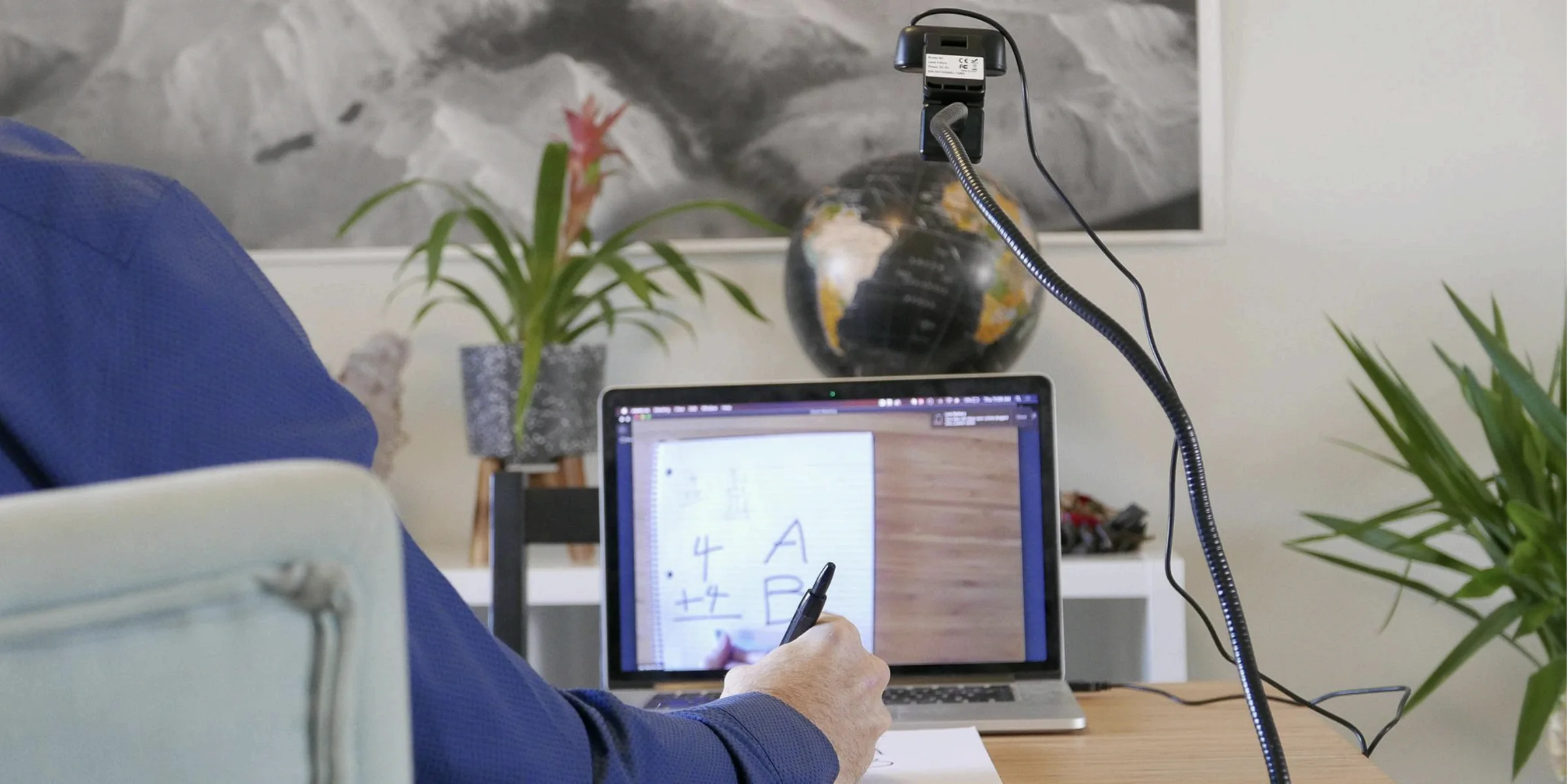
I researched a low-cost DIY alternative and found a webcam with a hinged base and tripod mount that paired well with a flexible, clamp-based phone stand designed for vlogging. Together, the parts met our resolution needs and fit the budget. We ordered them in bulk and assembled kits for every family before school began. I wrote a detailed parent guide, trained teachers using a train-the-trainer model, and integrated the cameras into classroom routines.
After months of consistent use, a ChromeOS update rendered the cameras nonfunctional on student-issued Chromebooks. With even less money remaining, we pivoted to a small IPEVO clip-on mirror that used the laptop's built-in webcam to mimic a document camera. We quickly trained teachers and families and distributed hundreds of mirror cams to finish the year.
That summer, I connected directly with manufacturers in China producing small, affordable document cameras with built-in software compatibility. After reviewing demo units and negotiating pricing, we selected a model that met our instructional and operational needs.
04 / Outcome
Outcome
The manufactured device became the long-term solution and remains a cornerstone of teaching and learning at Great Hearts Online. Students could show handwritten work in live Zoom lessons and photograph assignments for the LMS without giving up the school's paper-based practices.
05 / Key Learnings
Key Learnings
This project exemplified what I consider the heart of learning design: translating pedagogical intent into practical systems that work in the real world. It demanded attention to small material details—USB ports, camera angles, and clamp tension—while also requiring broad systems thinking across procurement, teacher training, student onboarding, LMS integration, and support documentation.
A good tool does more than meet technical specifications. It integrates into a learning routine, reduces friction, and helps teachers and students show up as their best selves. Our ability to prototype, iterate, and deliver a meaningful hybrid solution let the school stay true to its tradition while teaching in a completely new medium.