
01 / Background
Background
In the summer of 2016, I joined Denver Health, Colorado's primary safety-net hospital, as an instructional designer. I was charged with helping inpatient providers efficiently use Epic, the hospital's new electronic health record. Providers use it to view vital signs and lab results, write notes, and place every order for medication and procedures.
Denver Health had switched to Epic about five months before I arrived, and the transition was rocky. Many providers saw Epic as a time-wasting burden that interfered with patient care, while some colleagues described providers as prima donnas who refused training, ignored communication, and did not collaborate well.
02 / Purpose
Purpose
There was a clear disconnect between the developers and trainers on my team and the users we were meant to help. I cared about providers' frustrations with the EHR, but knew I could help them best if I understood them as people. They did not feel training was worth their time—but what was? They did not like using the EHR—but what did they value about their jobs? I needed to align training and communication with those values and develop solutions suited to their perspectives.
Shadowing users to learn their workflows was standard practice on my team. I decided to add direct user research and create provider personas.
03 / Process
Process
The user group included hundreds of people across more than a dozen specialties. I focused on the three largest: internal medicine, pediatrics, and surgery. Within each, I interviewed nurse practitioners, physician assistants, attending physicians, and residents.
I developed a fifteen-minute interview script organized around technology use, learning style, Epic experience, and work experience. Questions about work proved the most generative, eliciting longer and more emotionally rich answers, so I revised the script to prioritize them. Using snowball sampling after the first interviews, I eventually spoke with twenty providers over four months.
For analysis, I grouped providers by specialty, put every answer on a separate sticky note, and clustered similar responses to find patterns. I periodically invited coworkers to test my logic. Each specialty took about five hours to analyze, and I produced three personas for each.
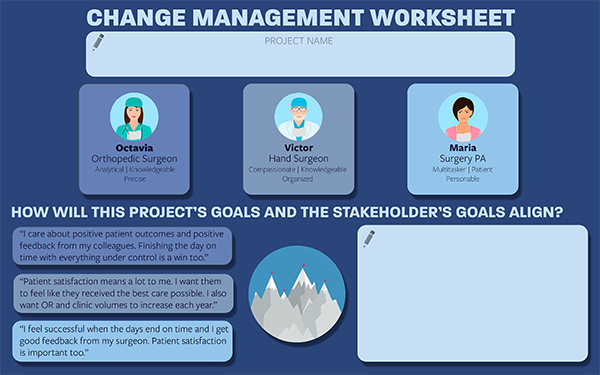
At the suggestion of my supervisor and a project manager, I also translated the personas into a worksheet. This change-management tool guided teams through questions intended to bring user perspectives into the beginning of a project. It could not substitute for involving stakeholders, but it could improve early thinking and generate better questions for user feedback.
04 / Outcome
Outcome
The interviews gave me a deep appreciation for how many providers saw hospital work as a calling, not simply a job. During one interview, a resident teared up while describing what it meant to work with Denver Health's most vulnerable patients. He thanked me for the chance to stop and reflect on the meaning of his work—a rare opportunity in the frantic life of a new doctor.
Understanding how my users saw their work also changed how I saw mine. I felt the reality of Denver Health's mission and felt grateful and humbled to play a small role in it. The personas remained useful throughout my time at Denver Health, particularly in the resident-orientation and weekly-communication work that followed. I presented the process at an Epic conference in 2018, to Denver Health's Epic leadership team, and to fellow instructional designers.
05 / Key Learnings
Key Learnings
People ignore communications and reject training opportunities for good reasons. Researching the values and perceptions of a reluctant learner group is the only way to find designs that can break through this resistance. The benefits of user research are both improved user trust, which increases receptivity, and insights into how to better appeal to them.